
I have a startup idea but no CTO. What do I do?
Short answer: You don't need to find a technical co-founder before you can move. Most non-technical founders get further, faster, by working with a fractional CTO — a senior technology leader who joins part-time to define your architecture, choose your stack, manage developers, and de-risk fundraising, typically for 60–80% less than a full-time hire. It's the fastest way to turn "I have an idea" into "I have a product" without giving up a founder's slice of equity to someone you just met.
If you're a founder with a validated idea, some early traction, or just a notebook full of conviction — and no technical co-founder in sight — this guide walks through exactly what your options are, what they cost, and how to pick the right one.
Why "find a technical co-founder" isn't the only answer anymore
For years, the standard startup advice was blunt: don't build a tech company without a technical co-founder. That advice made sense when writing software required a full-time engineer sitting next to you. It's outdated today, for three reasons:
- AI-assisted development has changed the math. Tools like Lovable, Bolt, and Cursor let non-technical founders get a working prototype live in days — but most of these prototypes hit a wall the moment real users, real data, or real payments show up. (We wrote a full breakdown of that wall in Scale Beyond AI Builders: How to Grow After Lovable, Bolt & Wix.)
- The fractional executive market matured. Fractional CTOs, CFOs, and CMOs are now a normal part of how early-stage companies operate — not a workaround.
- Giving up 15–30% equity for a co-founder is a permanent, expensive decision made under maximum uncertainty, before you even know if the idea works.
According to CB Insights' analysis of 431 shut-down, VC-backed startups, 43% failed due to poor product-market fit and 19% due to unsustainable unit economics — both of which are heavily influenced by how the product was built, staffed, and priced from day one. A rushed co-founder decision, or an unmanaged dev shop, is one of the more common ways founders end up in those numbers.
What does a CTO actually do that you can't skip?
Whether you hire one full-time, part-time, or never officially hire one at all, four things need to get done by someone with real technical judgment:
- Architecture and stack decisions that won't need to be rebuilt at 10x scale
- Hiring and managing developers or a dev team, including catching bad work before it ships
- Technical due diligence for investors, who will ask hard questions about scalability, security, and IP
- Build-vs-buy and cost decisions — what to build custom, what to use off the shelf, and what an MVP should (and shouldn't) include
Skip these, and you'll likely notice the gap only after you've spent your budget — usually as a product that can't scale, a security issue, or a "rebuild" quote from a second dev team six months in.
Your 4 real options when you have no CTO
1. Find a technical co-founder
Best for: Idea-stage founders willing to trade significant equity for a long-term technical partner who's as committed as you are. The upside is alignment — a co-founder is invested in the outcome, not the hours. The downside: it can take 6–12 months to find the right person, and the equity split (often 15–30%) is permanent and hard to unwind if the partnership doesn't work out.
2. Hire a dev shop or freelancers, and manage it yourself
Best for: Founders with real technical fluency who can write specs, review pull requests, and catch scope creep. This is the cheapest option upfront and the most expensive option if it goes wrong — non-technical founders often can't tell a good technical decision from a bad one until it's already built.
3. Build it yourself with AI tools
Best for: Very early validation — landing pages, clickable prototypes, internal tools. Fast and nearly free, but these builds hit a ceiling fast: authentication, payments, multi-tenant data, and real scale usually require a rebuild on proper architecture. Our AI Cost Calculator is a useful gut-check for what that rebuild is likely to cost once you're past the prototype stage.
4. Bring in a fractional CTO
Best for: Most founders , technical or not — who need senior technical judgment now, without a full-time salary or a co-founder equity grant.
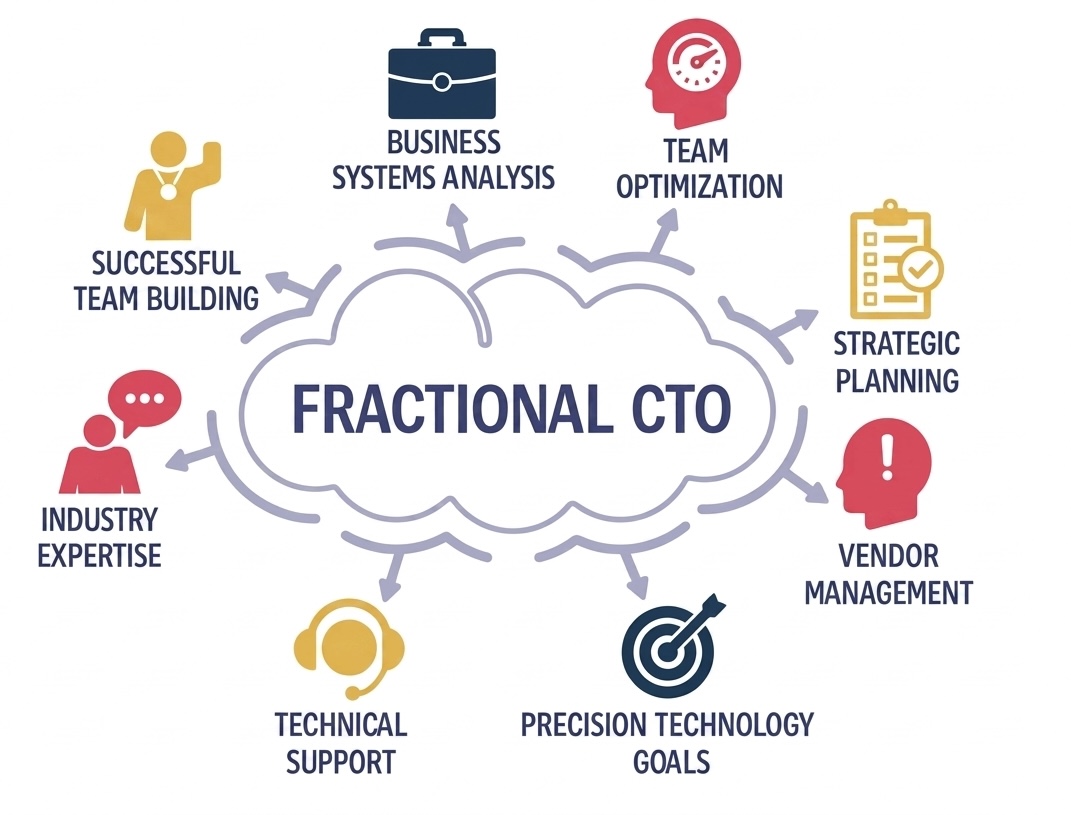
A fractional CTO gives you the architecture decisions, hiring oversight, and investor-ready technical story of a full-time CTO, scoped to the hours you actually need. Compared with the other three paths, it's the one option that combines fast startup time, no equity given up, and a named technical leader investors can actually talk to. You can be working with one within 1–2 weeks — similar to hiring a dev shop, but with none of the "hope they know what they're doing" risk, since the fractional CTO is the one vetting and managing that dev shop for you. A technical co-founder can offer that same investor confidence, but typically takes 6–12 months to find and costs a permanent 15–30% equity stake. Going the AI-builder route is faster and nearly free, but rarely scales past a prototype without a rebuild. A fractional CTO sits in the sweet spot: senior enough to be trusted with the big decisions, flexible enough to start almost immediately, and structured so you keep your equity unless you choose otherwise.
What is a fractional CTO?
A fractional CTO is an experienced technology executive who works with your startup on a part-time, retainer, or advisory basis — providing the same strategic technical leadership as a full-time CTO (architecture, team management, technical roadmap, investor diligence) without the six-figure salary, benefits, or founder-level equity. Engagements typically run 5–40 hours a month, and many founders start with a single working session to get unstuck on a specific decision.
Karen isn't preaching fractional work from theory — he's been living it for years, quietly running the technical side of several other people's companies while building BeeWeb with the other hand, all of it remote. At QuestionPro in Austin, Texas, he's been the person the business calls when strategy needs to turn into shipped software, a role he's held since 2020 without ever setting foot in their office. At Service Club in Barcelona, he took a marketplace from a blank repo and a single developer to a seven-person engineering team, redrawing the architecture along the way so it could actually carry the weight of scale — coordinated entirely from a distance. And in London, he built HotSpotz from a whiteboard idea into a live web and mobile platform, making the stack calls and the roadmap calls that decide whether an entertainment startup feels solid to investors or shaky under pressure, again without a shared office or time zone. Different industries, different continents, same instinct: walk into the technical unknown, make it legible, and stay accountable until it works, wherever the founders happen to be sitting. That's the muscle a fractional CTO engagement asks for — and it's the one Karen's been training for years before BeeWeb ever offered it as a service.
How much does a fractional CTO cost?
Costs vary by scope and experience, but industry data gives a useful range. An advisory-only engagement — roadmap reviews, architecture sanity checks, 5–10 hours a month — typically runs $3,000–$7,000/month. An ongoing fractional retainer, where the CTO is actively involved in decisions and dev oversight for 20–40 hours a month, typically runs $10,000–$25,000/month. Founders who just need occasional input often go hourly, at roughly $200–$500/hour.
Whichever structure you choose, it's typically 60–80% less than a full-time CTO salary, which runs $250,000–$400,000+ per year in the US once you add benefits and equity — and it comes with none of the permanent equity cost of a technical co-founder. The fractional executive category as a whole is growing fast: the market is projected to approach $15 billion by 2026, and roughly a third of US companies already use fractional leaders in some capacity, a share expected to keep climbing through 2026 according to industry tracking by JRG Partners.
Signs you need a fractional CTO right now
You're likely a good fit if any of these are true:
- You have a validated idea (or early users) but no one on the team can evaluate technical decisions
- You're about to hire developers or a dev shop and don't know how to vet or manage them
- You built a prototype with an AI tool and it's starting to break, or you're not sure it'll survive real users
- You're preparing for a fundraising round and investors will ask technical due diligence questions
- You need someone to translate "what the business needs" into "what gets built," without hiring a full executive
How BeeWeb's fractional CTO works
This is exactly the gap Karen Hovhannisyan, BeeWeb's Co-Founder & CTO, works with founders to close. Instead of a generic advisory retainer, Karen and the BeeWeb engineering team plug directly into your startup to:
- Review your idea and translate it into a realistic technical roadmap and architecture
- Recommend what to build first, what to defer, and what an MVP should actually include (see our MVP development approach)
- Vet, structure, or directly staff your engineering team through BeeWeb's dedicated development and custom software services
- Prepare your technical story for investor due diligence
- Stay involved as a technical advisor as you scale, without the overhead of a full executive hire
BeeWeb has spent 10+ years building products for startups and scaleups, and carries a 5.0/5.0 rating across 20 verified client reviews on Clutch — with clients specifically citing the team's combination of technical competence and business understanding, which is exactly what a fractional CTO relationship is supposed to deliver.
The easiest way to see if it's a fit: book a free call directly with Karen and walk through your idea. There's no obligation, and you'll leave with a clearer technical roadmap even if you decide not to work together.
Frequently asked questions
Do I need a CTO before I raise money? Not necessarily a full-time one. Investors care that someone credible is making your technical decisions and can speak to architecture, scalability, and security in diligence. A fractional CTO can fill that role and often join key investor calls.
How is a fractional CTO different from a dev shop? A dev shop builds what you ask for. A fractional CTO decides what should be built, in what order, and by whom — including managing a dev shop or in-house team on your behalf. Many founders use both together: a fractional CTO for strategy and oversight, and a dev team (in-house or agency) for execution.
Can a fractional CTO become a full-time or co-founding CTO later? Yes — it's a common path. Founders often start fractional to de-risk the relationship and the idea, then transition to a full-time or equity-based arrangement once there's traction to justify it.
What if I already built an MVP with an AI tool like Lovable or Bolt? That's a common starting point, not a dead end. A fractional CTO can assess what's reusable, what needs to be rebuilt on proper architecture, and how to avoid redoing the whole thing twice. See Scale Beyond AI Builders for the specific signs it's time to move off a no-code foundation.
How much time do I need to commit to work with a fractional CTO? Very little upfront. Most engagements start with a single consultation to scope the problem, then settle into a recurring monthly cadence (often 5–20 hours) depending on how active your build phase is.
Have a startup idea and no CTO? Book a free consultation with Karen Hovhannisyan, BeeWeb's Co-Founder & CTO, and get a technical roadmap before you spend a dollar on development.
Read also:
How to Protect Your Data When Building an AI Product
What to Do When Your Developer Disappears
My Software Project Failed: What to Do Next (Recovery, Code Audits & Rebuild Guide)